Friday, 17 April 2015

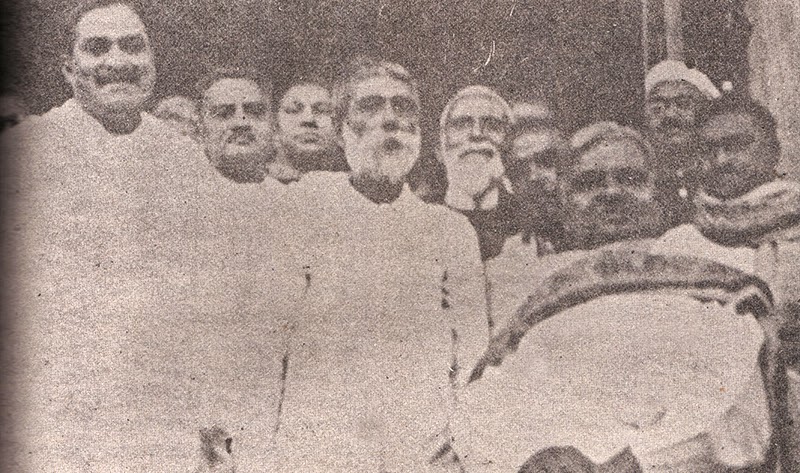
Remembering Kshitish Prasad Chattopadhyay… The ‘Renaissance Man’ of our City’s Primary Education

Kshitish Prasad Chattopadhyay
Amongst the visionaries who blueprinted Kolkata Municipal Corporation’s destiny Kshitish Prasad Chattopadhyay’s name stands tall, for his immense contribution in shaping the Corporation’s roadmap in the domain of education. In this piece, we pay our humble tribute to Kshitish Prasad ─ whose vision helped materialise Subhas Chandra Bose’s “mission of spreading primary education to the grassroots in Kolkata”.
Kshitish Prasad Chattopadhyay was born on December 15, 1897 in Kolkata. Chattopadhyay’s father, Yamani Mohan was the descendent of Raja Ram Mohun Roy, the ‘Bengal Renaissance Man’ and Ishwar Chandra Vidyasagar. While his mother, Motimala was the granddaughter of Dwarkanath Tagore.
In 1913 Subhas Chandra Bose passed the Matriculation standing second, while his batch mate Kshitish stood seventh from the Metropolitan Institution. This paved the way for Chattopadhyay’s brilliant academic career ─ two years later, he stood first in the ISC Examinations. In 1917 he passed BSc in Physics with first class and followed it up with his MSc in Anthropology from Cambridge University receiving ‘Anthony Wilkins Fellowship’ in 1922.
On his return to India Chattopadhyay joined Calcutta University as a Professor in 1923. In 1924 Deshbandhu Chittaranjan Das assumed office of the Mayor in Calcutta Corporation and appointed Subhas Chandra as its first Chief Executive. It was on Bose’s behest that Kshitish Prasad was chosen as the Corporation’s Education Officer.
What followed was unprecedented in the history of the Corporation, not to mention the City. Under Chattopadhyay’s stewardship the number of Corporation Schools swelled from a meagre three to a total of 232. A momentous feat that changed the face of primary education of Kolkata forever.
Till 1935 he served Calcutta Corporation as the Education Officer and then, on the invitation of Shyama Prasad Mukherjee, once again joined the Calcutta University. A man of scholastic proportions, Kshitish Prasad, a student of WHR Rivers in his later life also Headed the Department of Anthropology, University of Calcutta.
A recipient of the prestigious Sarvabhauma Award from the Calcutta Pandit Samaj, Kshitish Prasad was a member of Permanent Council of International Congress of Anthropology. He passed away on March 31, 1963.

Monday, 13 April 2015

Abinash Chandra Bhattacharya: A Tribute to A Forgotten Scribesman


In the annals of the Corporation’s history, there have been several prominent leaders, visionaries and change agents — some remembered, others whose remarkable contribution have been forgotten over the passage of time — today we are honoured to remember one such outstanding individual, our very own Abinash Chandra Bhattacharya.
Abinash Chandra Bhattacharya was born on April 5, 1882 in the village of Arabelia in North 24 Parganas district. A young man of exceptional ability, Bhattacharya around 1902 was inspired by heroics of eminent freedom fighter Jatindranath Bandyopadhyay and joined the India’s struggle for freedom.
In 1905 during the protest against Partition of Bengal, he met Aurobindo Ghosh and in 1906 after the birth of Jugantar magazine — a prominent mouthpiece of the radically inclined freedom fighters — Bhattacharya was appointed as its Manager.
In 1909 he was one amongst many who was convicted in the “Muraripukur Bomb Case”. Five years after his release in 1920 Bhattacharya joined the Swarajya Party of ‘Deshbandhu’ Chittaranjan Das and took over the charges of Narayana magazine. This apart, he was also associated with several other magazines like Bijali and Atmashakti, to name a few.
In 1924, after the Calcutta Municipal Gazette came into being, Bhattacharya was roped in to assist the journal’s renowned editor Amal Home. A true man of letters, Abinash Chandra Bhattacharya worked for Calcutta Municipal Gazette — leaving his inimitable mark —till 1941.

Wednesday, 8 April 2015

Quenching Kolkata’s Thirst… A Brief History of the City’s Water Supply System (1700s ~ 1950s): Part 2

A view of the under construction Tallah Tank

With the inclusion of the southern suburbs within the municipal area in 1888, there was need to increase the supply of water. During 1888-1891, some extension works were carried out. These included:
  • Construction of a new Pumping Station with three 75 HP pump sets at a distance of about half a mile (0.8 km) from the old station at Palta
  • Excavation of four large kutcha settling tanks/reservoirs with a total capacity of 82.75 million gallons (376 million litres) Construction of twenty-four additional slow-sand filter beds
  • Laying down of a new 48-inch (1219 mm) diameter cast-iron pipe, 66,000 feet in length between Palta and Tallah, to convey the increased supply of water to the city
  • Strengthening of the works at Tallah by the addition of two new pumping-engines, while the reservoir accommodation was increased
  • Installation of an additional pumping-engine at Wellington Square Station, and construction of a new pumping station at Halliday streets, with four beam-engines and an underground reservoir of 4 million gallons (18.18 million litres) capacity
  • Construction of a new pumping station at Bhowanipore for the supply of the southern suburbs newly incorporated in the Municipality. This pumping station was fitted with two triple-expansion Worthington engines and provided with an underground reservoir of nearly 3,000,000 gallons capacity (13.64 million litres)

The new works were completed in 1891. Subsequent minor alterations included the installation of a new Worthington pumping-engine at Tallah, capable of raising 9,00,000 gallons per hour (1894), and two triple-expansion Worthington engines (1898) engines.
During 1891-1900 considerable extensions of filtered water mains were carried out. Attention was drawn in 1901 to the need of a continuous system of water supply through elevated reservoir. It was proposed to abandon the three pumping stations at Wellington Square, Halliday Street (the present Muhammad Ali park), and Bhowanipore and to substitute them with a system of gravitation by using the pumps at Tallah to raise the water into an elevated steel tank or reservoir. It was also proposed to construct two such reservoirs, one for the north and east, and the other for the south of the town.
The Government agreed to the proposal with some modifications and executed the plan by 1902. A new Worthington engine with a pumping capacity of 22 million gallons (100 million litres) a day was installed at Palta in 1900 and in 1902 steps was taken to construct an additional reservoir of 5 million gallons (22.73 million litres) capacity at Tallah. By 1903 the supply per day was 22 million gallons (100 million litres).
A fresh scheme was submitted in 1903. The principal features of which were — the laying of a new 48-inch main from Palta to Tallah to deliver an additional supply of 12 million gallons of water, and substitution of gravitation for pumping as a method of distribution.
There was a serious demand for increasing supply even after it was increased from 20.5 million gallons (93.2 million litres) to 26.5 million gallons (120.5 million litres) a day by 1905. To meet this increasing demand, the Corporation sanctioned another scheme in 1907 and the Government in 1908.
The works were duly executed by 1911, increasing the supply from 26.5 million gallons to 32 million gallons (145.5 million litres) a day. After the completion of these schemes, the practice of storing and boosting filtered water supply from the underground reservoirs and pumping stations was abolished. The total supply again rose to over 36 million gallons (163.7 million litres) in 1913-1914, and in 1921 it was a little over 38 million gallon (172.7 million litres).
 The number of house connections in 1920 was 37,023 that included 2,684-metered connections. For the purpose of waste prevention, the whole city was divided into 238 water meter districts. The total length of filtered water mains rose to 385 miles (616 kms). However, the objective of continuous high-pressure supply throughout the day could not be achieved because of excessive wastage. Moreover, there was an acute shortage of water especially during the hot weather in the southern parts of the city. In order to maintain a continuous supply at a minimum terminal pressure a new scheme was submitted and was approved by the Corporation in 1921. This estimate was, however, subsequently revised for supplying water to the areas newly added to the city in 1924.
With the help of the existing and the newly constructed mains as mentioned above, arrangements were made for delivering water from the Tallah pumping station to different parts of the city through the various zone mains. These projects, completed between 1922 and 1936 quenched the city’s thirst, till well into the 1950s.
Supply of Unfiltered Water to The City
The supply of ‘Unfiltered Water’ in the city dates back to 1820. When the filtered water supply was found inadequate to meet the demands of the town, William Clark proposed to economise its use by an extension of the unfiltered supply in 1871. The unfiltered water supply was mainly used for the purposes of watering roads and flushing of sewers and privies.  The old pumping machinery at Chandpal Ghat was utilised for this purpose.
The transfer of the Chandpal Ghat Pumping Station site to the Port Commissioners followed the extension of the unfiltered water pipes from 1871. The Port Commissioners handed over to the Corporation a new site at Mullick’s Ghat on Strand Road, south of Howrah Bridge approach.
New pumping and machinery was installed at this site in 1885, but, it made way in 1897 for the existing plant that consisted of four 300 HP vertical triple expansion Worthington engines, each capable of pumping a million gallons (2.273 million litres) per hour against a head of 120 feet (36.6 m). Each engine was provided with a separate suction pipe laid in tunnel under the Port Commissioners’ railways up to the retaining wall at the riverbank. This pumping station supplied all the unfiltered water required for the town area. The tunnels and the jetty were the property of the Corporation.
In 1897 another pumping station for unfiltered water supply was constructed at Watgunge, on the river Hooghly near the mouth of Tolly’s Nullah. Two horizontal pumping engines, each capable of pumping 300,000 gallons (1.36 million litres) per hour against a head of 120 feet (36.6 m) that were earlier installed at the Mullick’s Ghat Pumping Station, were shifted and installed here.
The two pumps drew their water from common suction pipe laid in a tunnel from the station to a screw pile jetty that supported the pipe up to the water in the river.
The Watgunge Pumping Station supplied water to District IV and the Maidan area.  The supply of unfiltered water grew from a little over a million gallons (4.546 million litres) per day at Chandpal Ghat to 33 million gallons (150 million litres) per day from Mallick Ghat and Watgunge Pumping Station in 1921.
No further development works relating to water supply were taken up between 1936 and 1945 chiefly due to resource constraints and political upheavals.

A view of the Chandpal Ghat (circa 1940s)
concluded

Tuesday, 7 April 2015

Quenching Kolkata’s Thirst… A Brief History of the City’s Water Supply System (1700s ~ 1950s): Part 1


An adequate supply of pure water, along with an efficient drainage and sewerage system, is most essential to ensure good health of a population. Although the consumption of water depends upon climatic conditions, standard of living and habits of the people, a daily supply of 150 to 200 litres (34~40 gallons) per head is considered an adequate allowance.
Supply of Filtered Water to The City
In its early years, Kolkata, or, the then Calcutta had its water supply from open tanks, wells and the river Hooghly. The staunch Hindus used nothing but Ganga waters from the Hooghly River. A certain Baboo Baishnacharan Sheth of Burra Bazaar made a fortune by supplying the holy water to far off places. Wealthy Hindus got their supplies either from Hooghly Town or from Khulna for the apparently purer flow there. The water would be filtered through sand and charcoal, after immersing a red-hot iron rod into it and stored in Pegu jars for as long as a year. The river water was fit for drinking only from October to March. From April till the onset of the monsoons, it was saline. The water when turbid was clarified by alum and strained through cloth. Some people collected rainwater and used it when the river water became turbid during the rainy season.
            In the native part of the city, numerous private wells supplied water to the poorer people, living away from the river. These privately owned tanks were foul smelling and unsanitary, and the water too polluted for human consumption. The Europeans often used stored rainwater. The Great Tank at Dalhousie Square (now BBD Bag), popularly known as Lal Dighi, was enlarged and deepened in 1709 to ensure a good supply of sweet water to the garrison at Old Fort William and for the British in Calcutta. Many private tanks were also excavated but subsequently decayed due to absolute neglect.
            Not much initiative was taken by the European authorities to improve the civic amenities of the city even after it became the capital of British India in 1773. In fact, it was only in the early nineteenth century that things began to improve.
            At a meeting of the “Town Improvement Committee” held on June 16, 1803 Lord Wellesley admitted: “It is a primary duty of the government to provide for health, safety and convenience of the inhabitants of this great town by establishing a comprehensive system for the roads, streets, paths, drains and water by fixing permanent rules for the construction and distribution of the houses and public edifices and for the regulation of nuisance of every description”. It was during his regime that the “Town Reforms Committee” was formed for improvement of the town. Since the construction of the public drains and watercourses of the Town was extremely defective, he assigned great importance to the improvements of its drainage and water supply systems.
            This led to the appointment of a Committee in 1804 to look into the matter. This “Improvement Committee”, later called the “Lottery Committee”, undertook extensive development work for the city.
            The Lottery Committee excavated a number of tanks between 1808 and 1837, chiefly along the arterial road from Lower Circular Road to Shyambazar at Cornwallis Square, College Square, Wellington Square, Mirzapur, Soorti Bagan, along with several tanks in Shorts Bazaar.
The ‘native town’ too had a number of private tanks, sometimes open to the public. By 1847, the total number of tanks within the Maratha Ditch was 1,043. It appears from the Administrative Report of the Calcutta Municipality for 1,877 that there were within the boundaries of the city some 800 tanks covering an area of 146 acres. In the suburbs, Bhowanipore alone had 823 tanks in 1888.
However, with the growth of population, the existing system was found inadequate, and by 1820, a small pumping plant was set up at Chandpal Ghat for lifting river water into open masonry aqueducts that distributed the water by gravitation over a small portion of the town comprising Old Court House Street, Dharamtola, Chowringhee, Park street, part of Chitpore Road, Lal Bazaar, Bow bazaar, etc; The aqueducts were filled with water pumped from the river Hooghly by a small pumping station at Chandpal Ghat and settled into a settling tank from where the water flowed into the aqueducts by gravity. Water could be taken from the aqueducts by buckets and the supply was also used for street watering and replenishing the public tanks.
The authorities for the first time recognised the need for pure and wholesome water in 1848 and passed the legislation Act II.  The Commissioners subsequently spent large sums for repairing the public tanks. In 1854, the system of aqueducts was extended to Wellington Street, Wellesley Place and College Street. The cost was borne by the Government and the public.
Clark recommended the use of cast-iron pipes laid underground, through which water could be forced from Chandpal Ghat. The Commissioners, however, on the grounds of expense and delay in obtaining materials from England, did not favour the innovation.
Between December 1861 and January 1863 an elaborate analysis of the Hooghly water was carried out by collecting samples from the centre of the stream at 6 feet below the surface at three stations, namely from opposite Cossipore, Palta Ghat and Chinsura.
It was observed that the Cossipore water was tainted by sewage, and the plan of placing the intake pipes at this point, courtesy low cost, was abandoned. The analyst reported that water drawn either at Palta or Chinsura was comparatively pure, and after settling and filtration would give a pure and wholesome supply. Clark’s original scheme provided for a daily supply of 3 to 4.5 million gallons of water.
In 1865 Clark submitted a full report on the Palta scheme that was approved in its entirety by the Water Supply and Finance Committees of the Corporation, who recommended that the works should be carried out by contract under the supervision of the Justices, instead of the supply being placed under the control of a water company.
The first water works for the supply of filtered water to the City was built at Palta (about 30 kms north of the City Centre situated between Barrackpore and Naihati) and took three years (1867-1870) for its construction. It was designed for supplying 6 million gallons (27.28 million litres) of treated water every day to a population of 4 lakhs, thus giving a per capita supply of 15 gallons (68litres) per day.
In order to obtain the full advantage of the waterworks and to avoid the depreciation that iron pipes were expected to undergo owing to the salinity of the soil, Clark was in favour of conveying the water from Palta by a brick aqueduct instead of through iron pipes, but his views were subsequently modified. 
Two pumping stations were built — one at Tallah and the other at Wellington Square — along with two underground reservoirs with capacities of 1 million gallons (4.546 million litres), and 6.25 million gallons (28.41 million litres) respectively. The filtered water from Palta to Tallah was conveyed by gravity through a 42 inches (1067 mm) diameter cast-iron main laid at a gradient of 1 inch. Water used to be pumped from Tallah under pressure partly to the consumers direct and partly into the underground reservoir at Wellington Square from where again water used to be pumped to the consumers.
The daily consumption of water was 4.5 million gallons (20.5 million litres) by 1870, and all the principal streets and lanes (385 in number) were piped, to a total length of piping aggregating 111.75 miles (179 kms). Over 500 stand posts were erected in the streets and made accessible to the public. 
It was soon found that the working of the filters was unsatisfactory during the rainy season. In 1871 thus, engineers proposed to increase the number of filters and to make other extensive works. With the increasing demand for filtered water the problem of water wastage began to assume great importance.  As a measure of economy, the extension of the unfiltered water supply was extended for street watering, fire prevention and trade.    Gradually, an additional engine was installed at Tallah, the pumping plant at Chandpal Ghat was strengthened, and unfiltered water supply was further extended.  The supply of filtered water, however, did not exceed 7 million gallons daily. It soon became evident that the works should be enlarged.
to be continued 

Saturday, 4 April 2015

Civic Reception to Acharya Prafulla Chandra Roy


In 1924 Acharya Prafulla Chandra Roy — recipient of the first ever “Chemical Landmark Plaque” outside Europe by the Royal Society of Chemistry, who was also the founder of Bengal Chemicals & Pharmaceuticals, India's first pharmaceutical company — was appointed the first chairman of the Corporation’s “Education Committee” by then Mayor ‘Deshbandhu’ Chittaranjan Das. Acharya Roy, in his new role, blueprinted for the first time a proper, ‘vision-oriented’, modern syllabus for the Corporation’s Primary Schools.
It was, therefore, as a recognition of Acharya Roy’s immense contribution in shaping the City’s Primary Education system the Corporation decided to celebrate the 71st birthday of this great ‘son of the soil’ — with a grand Civic Reception.
On December 10, 1932 — a Saturday — at Town Hall, Kolkata the then Mayor of Kolkata Dr Bidhan Chandra Roy — accorded Acharya Prafulla Chandra Roy in a befitting ceremony with the Reception on behalf of his fellow citizens. On this occasion, Acharya Roy was also presented with a silver ‘Charka’ — an inimitable symbol of Swadeshi enterprise.

Thursday, 2 April 2015

Central Municipal Office Building… A Journey Through The Ages

Central Municipal Office Building… then

In 1948 the office of the Municipal Commissioner was located at 11 Esplanade Row. The building was procured at a monthly lease of Rs 300. Even after a change in office premises, the space seemed inadequate due to the growing requirements of the Corporation. In fact, the various stores were scattered at different places like the Chandpal Ghat, Bonded Warehouse, Beliaghata and one at even Kotrung Depots.
In 1860, the Central Municipal Office Building was shifted to the spacious premises at 1 Chowringhee Road — that had a large compound along with ‘out offices’ — for a monthly rent of Rs 500. This arrangement seemed adequate till 1872 when it was resolved to construct an exclusive Central Municipal Office Building at a cost of about Rs 1 Lakh except the site value.
The Municipal Office buidling were designed by Mr Osmond of Messrs Mackintosh, Burn and Company at a cost of Rs 1,91,000 including Rs 65,000 for the land. Between 1885-86 the Central Municipal Office building was expanded at an expense of Rs 22,000 and in 1901 it was fully remodelled. The total cost amounted to Rs 5,90,000.
Presently the total area under Central Municipal Office Building is 6 Bigha 16 Cottah and 4 Chhatak.
Central Municipal Office Building… now

Wednesday, 1 April 2015

Mackenzie Bill & Charge of The Indian Brigade

Among the controversial actions that brought Lord Curzon into confrontation with the early Indian nationalists, historians have given most emphasis to the reform of the Indian Universities and the partition of Bengal; the then Calcutta municipal reform of 1999 receives only passing mention. Yet this episode is of equal interest in understanding the dynamics of the Curzon regime.
It is important if only because it provided the occasion for Curzon's first decisive intervention in local affairs, for although he did not initiate the legislation he substantially influenced decisions that might have been made routinely by the Government of Bengal.
This drew him into the vortex of city’s politics and shaped his perception of the capital's affairs for the remainder of his term of office. For Bengali nationalists the agitation against the municipal reform became the most prolonged and far reaching campaign they had so far organised.
By the end of the nineteenth century, the managing body of the city had become practically a ‘by-word’ for controversy in India. Since the 1860’s, the major conflicts in municipal politics had been generated by the system of ratepayer representation on the municipal corporation, the distribution of power within it and the alleged consequences for municipal progress.
Under the 1888 amendment to the Municipal Act of 1876 that had initiated an elective system, two-thirds of the municipal commissioners were elected by qualified ratepayers in the city’s 25 wards: two for each ward.
Special constituencies elected further ten commissioners: four each by the Bengal Chamber of Commerce and the Calcutta Trades Association and two by the Port Commission (often referred to as the “commercial seats”). The lieutenant governor of Bengal nominated the final 15 members of the 75 commissioners.
The majority of enfranchised ratepayers were Hindus (73 per cent of the 13,890 voters in 1898). But their dominance of the electorate was somewhat lessened by the system of plural voting and the distribution of seats in relation to the Ward population. In the election of 1897 Hindus secured 36 of the 50 Ward seats. The British residents, comprising three per cent of the city’s population, constituted 15.4 per cent of the electorate and commanded 19.4 per cent of the voting power. The block of “Commercial Seats” further enhanced their representation on the Corporation. The Muslims benefitted least from these arrangements. With 28 per cent of the population and 10.5 per cent of the electorate, they held only nine per cent of the voting power.
The men most successful in municipal elections and most prominent in the Corporation were largely high-caste Hindu professional men, many of them lawyers, who were almost invariably affiliated with the leading political clubs of Calcutta, the Indian Association and the British Indian Association, and supporters of the Indian National Congress. A core of elected commissioners had served on the Corporation and the general committee since the introduction of the elective system. 
 
Among these were Surendranath Banerjea, Narendra Nath Sen and NN Ghose all of whom had become prominent as public figures from the initial basis of municipal work. However, it is important to note that these men had their differences of opinion on municipal matters and the Hindu commissioners as a whole (including nominees) were a diverse collection of professional men, businessmen and property holders.
The European commissioners, too, were a mixed lot — including some ICS officers, doctors, lawyers and tradesmen — but they shared a record of short periods of municipal service, low attendance at meetings and reluctance to serve on municipal committees. By the 1880s the Muslims were beginning to be concerned about their representation in municipal government, but at best they could only command a dozen seats (including nominated ones).   In general they supported the “government line” in municipal matters.
Critics of the elective system, drawn from both the unofficial European community and the ICS, maintained that it had allowed Bengali Hindus to “capture” municipal government, overpowering the British commercial interests. The “Hindu clique” was held responsible for the slow progress of municipal projects. Sir Alexander Mackenzie, lieutenant governor of Bengal, voiced an extreme expression of those charges in 1897:
“For the past ten years it (the Calcutta Corporation) has been dominated by Bengali Hindus. It embodies their idea of what a Bengali Parliament should be, and it gives the fullest expression to the demoralising doctrine that practical considerations are to be subordinated to the supposed educational influences of Local Self-Government.”
For their part, the active Hindu commissioners argued that the British citizens of Calcutta had largely boycotted the elective system while they (the Hindus) conscientiously carried the burden of routine municipal management, against a background of unwarranted carping from the provincial government. The city’s lack of progress in municipal improvement; they claimed, was due to British apathy, financial constraints and outright executive inefficiency.
Tensions were brought to a head by the plague scare of 1896. When the pestilence was reported in Bombay, there was a panic reaction in Calcutta and the interest groups of British Indian commerce called for the suspension of the Corporation on the grounds that the commissioners were unfit to deal with a sanitary crisis.
Sir Alexander Mackenzie took the opportunity to act. Charging the Bengali Hindu commissioners with inefficiency, over-talkativeness, interference in executive matters and municipal corruption, the lieutenant governor, largely guided by HH Risley, then secretary to the Government of Bengal brought forward legislation to amend the Calcutta Municipal Act.
What Risley proposed instead was a change in the distribution of power within the Corporation through an alteration of the relations among its components: the executive, the general committee and the body of commissioners. The body of commissioners was to be stripped of its former supremacy in the municipal system, full executive power was to be vested in the municipal chairman and the composition of the general committee was to be altered so that the elected ward commissioners would be decisively out-numbered. The Bengal Government saw this last provision as crucial — it would ensure that supporters of the government would have a dominant voice on the Corporation's policy-making committee.
In attempting to overcome the objections of the Government of India to the legislation, Mackenzie underlined his motives: the Government had to act to “shift the power to the disadvantage of the Hindu oligarchy”, and gain influence over even the minor decisions of the municipal administration.
Between September and December 1897, the viceroy Lord Elgin, attempted to persuade Bengal to drop or to moderate the legislation. Both he, and the new secretary of State, Lord George Hamilton, felt Mackenzie had blundered seriously in his charges against the elected Hindu commissioners, which the lieutenant governor had been unable to substantiate.
HH Risley introduced the Calcutta Municipal Bill in the Bengal Legislative Council in March 1898. Bengali politicians were primed to defend what was considered the most “liberal” municipal constitution of the presidency capitals.
A handful of men — mobilised by Surendranath Banerjea and NN Sen — organised the initial agitation. As their movement grew they became popularly known as “the opposition” being referred to privately by members of the ICS as the ‘Baboo Party’. While they had little initial success in gaining the support of representatives of the European and Muslim communities, by February 1899, they had argued their case cogently enough and had demonstrated sufficient diversity of support in Calcutta to give Lord George Hamilton pause.
In fact, in a historic move on September 1, 1899 as protest against the Bill 28 commissioners led by Surendranath Banerjea resigned from their posts. This drew the final straw as Hamilton decided that the “Mackenzie Bill” must be scrapped and he saw the change over of viceroys as an opportunity to recommend face-saving changes in the legislation.