Showing posts with label Strand Road. Show all posts

Saturday, 16 May 2015

Ghats of Kolkata… Revisited: Baboo Ghat

Baboo Ghat: Circa 1880
In 1823, Rani Rashmoni’s father breathed his last. In order to perform his post-cremation rites Rashmoni visited a ghat on the banks of Hooghly — she was pained to see the dilapidated state of the ghat and left soon after offering her prayers. On her return to the Janbazar Palace, Rashmoni requested her husband Raj Chunder to renovate the ghat.
            Moved by his wife’s empathy Raj Chunder first approached the concerned Garrison Officer of the area. Thanks to the mediation of the Officer, Raj Chunder met Lord William Cavendish Bentinck, the then governor-general of Bengal. Raj Chunder sought permission to build a ghat on the Hooghly and construct the approach road from Janbazar to the precincts of the ghat. Bentinck appreciated the merit of the initiative and summarily gave his stamp of approval to the projects.
            The Ghat was completed first and inaugurated in 1830. Even today one can see a plaque on the façade of this Ghat that is made up of thirty-six pillars and an Ionic style parapet. It reads:
The Right Honourable Lord William Cavendish Bentinck, G.C.B. & G.C.H. Governor General & c. & c. & c. with a view to encourage the direction of private munificence to works of public utility has been pleased to determine that this Ghaut constructed in the year 1830 at the expense of Baboo Raj Chunder Doss, shall hereafter be called Baboo Raj Chunder Doss’s Ghaut.
It needs to be noted that at the time of the Ghat’s construction, Strand Road was lower than its present elevation. The water level, therefore, was parallel to the Road on the other side of the Ghat right below the steps. Supply of water from the Hooghly was accommodated through eight Gullyghars that were constructed for this specific purpose by the Ghat.
One would take the steps to reach the waters of Hooghly — as such this meant that from a distance, Baboo Ghat had remarkable resemblance to a two-storied house. While the lower level was used for bathing purposes, the upper level acted as the venue for performing religious rites. It is also interesting to note that the upper level had verandah and tastefully guarded by balustrades on all sides. This meant that one could not directly access the Hooghly from this level. The steps that we see at present were added later.
   The lower level of Baboo Ghat was buried at a later date when Strand Road’s level was raised — first by soil filling and then with construction of the metalled road.
Baboo Ghat: At present

Thursday, 30 April 2015

‘Song of the Road’… A Brief History of the City’s Roads (1700s ~ 1900s): Part Two

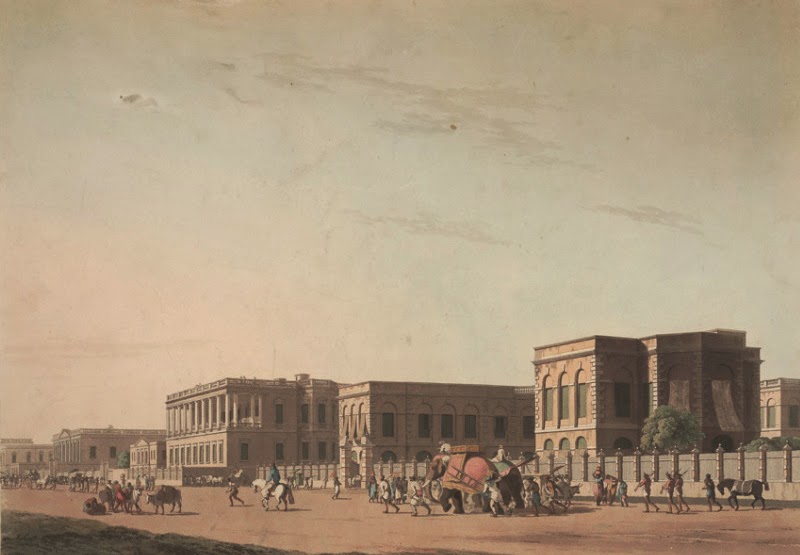
Council House Street

The peace and prosperity following the Battle of Plassey induced people from the surrounding areas to settle in Calcutta. Kutcha roads in the new localities inhabited by the natives were full of cesspools. Wealthier natives constructed roads leading to their houses in the town, or, suburbs. It is, however, interesting to note that most of the highways from Calcutta to the suburbs were constructed during the days of the Zamindar.
Steps were also taken to construct bridges over Dullendaw, Manickchurn, Gopalnagar, Dum Dum, Barasat and Beliaghata Canal in 1766.
The Justices of the Peace for Calcutta relieved the Zamindar of his municipal duties in 1794 and were authorised to levy a 5 per cent surcharge on property tax for appointing scavengers, cleansing, repairing and watching the streets. They also took steps to metal the Circular Road in 1799. The limited resources placed at the disposal of the Justices did not permit them to take up large-scale development works like construction of new roads, bridges etc; in the town.
The East India Company was always unwilling to part with their revenues for municipal improvements.  Funds had to be raised from the public for development works.   Lotteries came to the aid of the community from 1784 in the creation of public assets. It was the appointment of Wellesley’s ‘Town Improvement Committee’, later known as the ‘Lottery Committee’ (1804) that took up the initiative to improve the public thoroughfares of the city. Calcutta owes some of its best roads to the labours of the Lottery Committee (1825~1836). The roads include: Wood Street, Wellesley Street, Wellington Street, College Street and Cornwallis Street; Strand Road from Prinsep Ghat to Hatkhola; Amherst Street; Hare Street; Waterloo Street; Elliot Road; Short Street; and Colotolla~Mirzapur Street.
A group of streets that commemorated the various titles of Lord Hastings and his wife, were also the work of the Lottery Committee and were designed to afford access to the Panchkhotee, or, Five Mansions. Thus credit goes to the Lottery Committee for reconstructing chaotic Calcutta into some orderly shape of a modem town.
Circular Garden Reach Road that was called “Strand New Road to Garden Reach” was constructed in 1828, with contributions from 58 persons. As public opinion in England condemned the method of raising funds by lotteries for improvement of the town of Calcutta, the Directors of the East India Company in 1836 ordered their closure.
Lord Auckland (1836-1842) appointed the ‘Fever Hospital Committee’ to carry on the work of the Lottery Committee. But the new Committee was more concerned with community health than with roads. The Committee reported that the streets in the native part of the town were narrow and haphazard without any free circulation of air. They were always covered with filth, dust, mud or offal that were rarely cleaned by the scavengers leading to pestiferous air.
It was as the result of this Report that Bustees were cleared by the Justices of Peace between 1854 and 1876 for the construction of Halliday Street, Free School Street, and an extension from Corporation Street to Dharamtollah Street, Clive Row Extension, Beadon Street, Beadon Square, Grey Street, Allen Square, Outram Street, Grant Street and the Victoria Terrace.
Construction of new roads and maintenance of the existing ones were within the exclusive jurisdiction of the Municipal Corporation of Calcutta from 1876 to 1911. The Corporation mostly cleared or improved the Bustees to build roads in the town. The Calcutta Improvement Act of 1911, created a board of trustees charged with the duty of “opening up congested areas, laying out or altering streets, providing open spaces for ventilation or recreation”.
The Calcutta Improvement Trust opened up a north-south and an east-west corridor (Central Avenue and Rashbehari Avenue) and many other roads in the city.
The completion of the underground drainage and water supply schemes resulted in the construction of the Suburban High Level Sewer Road and the conversion of many open drains or ditches into narrow lanes. The implementation of the Canal Area (between Circular Canal and Upper Circular Road) Drainage Scheme in 1907 resulted in the construction of 11,596 feet of roads, 60 feet in width and 13,970 feet of new roads, 40 feet in width, in addition to the widening of the existing ones.
It took another 40-odd years before further development works of new roads in the city were planned.
concluded